
Brown County Court Dockets list scheduled court cases, hearing dates, and filing activity within county courts. They help residents, attorneys, and researchers follow court schedules and case progress. Brown County Court Dockets present daily court activity in an organized format. Each docket entry shows case numbers, party names, and docket listings. Hearing dates appear clearly to support timely court appearances, and the court calendar Brown County provides reflects current court activity.
Brown County Court dockets support public review of court proceedings by providing structured and timely access to case activity. Attorneys rely on Brown County Court docket listings to track hearing schedules, judge assignments, and the progression of active cases. Residents use these records to follow hearing dates related to local legal matters, while researchers analyze the court calendar that Brown County Court maintains to identify procedural trends and case patterns. Frequent updates help ensure court records remain accurate and reliable. Docket listings also reflect case status changes, such as continuances or newly filed documents, allowing users to monitor developments efficiently.
What Are Brown County Court Dockets?
Brown County Court Dockets are official schedules and tracking logs for court cases filed in Brown County. They show how a case moves through the court system, from filing to final action. A court docket works as a case timeline. It lists every formal step taken by the court and the parties involved. Each entry appears in date order, which helps readers follow progress without reading full documents.
What information does a Brown County court docket include?
Each docket entry provides clear, factual case details. These details help readers confirm case activity and upcoming events.
Common items found on Brown County Court Dockets include:
- Docket number used to identify the case
- Party names such as plaintiff and defendant
- Case types like criminal, civil, probate, or family
- Filing dates and court actions
- Hearing dates and courtroom details
- Motions, rulings, and judge assignments
- Current case status, such as open, pending, or closed
Daily updates often appear in a daily docket, which reflects recent filings and scheduled hearings. This format supports attorneys, reporters, and residents who track court timelines.
Docket vs. full court record
A docket does not contain every document filed in a case. It acts as a summary log rather than a full case file. A full court record may include complaints, evidence, transcripts, and signed orders. By comparison, a docket points to those items without displaying them. Readers often start with the docket to confirm activity, then request specific documents if needed. At the same time, dockets save time by showing progress at a glance. Court staff rely on them to manage calendars and workloads.
Public viewing and transparency
Brown County court dockets remain part of open court records. State policy supports public viewing of case schedules and actions, with limited exceptions for sealed matters. This open format promotes transparency and trust in court operations. It allows residents to check hearing dates, confirm filings, and follow outcomes using reliable court data.
How to Search and View Brown County Court Records
Searching Brown County court records starts with knowing the correct method for a court case lookup and where to find the official online tools. Users can search by name, docket number, or hearing date to check case status updates quickly and accurately.
How to Search Brown County Court Records Online
The easiest way to begin is by using the official online search system provided by the state or county court. For Brown County, Wisconsin, the state’s public case search tool is the Wisconsin Circuit Court Access (WCCA).
Steps to Look Up Wisconsin Circuit Court Records
- Visit the Wisconsin Circuit Court Access case lookup page:
https://wcca.wicourts.gov/case.html
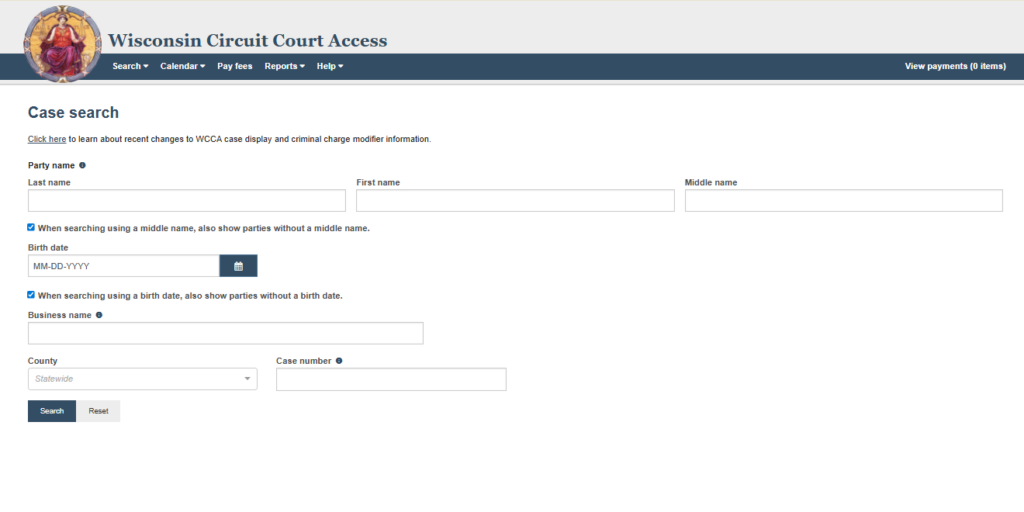
- Type the surname of the individual connected to the case.
Adding a given name or middle name can improve search accuracy. - Enable the option that allows results to appear even if a middle name is not listed.
- Enter a date of birth if available to further narrow down results.
You may also include entries that do not show a birth date. - If searching for a company or organization, use the business name field instead of a personal name.
- When available, input the case number to quickly locate a specific record.
- Choose a specific county, or leave the selection as statewide to search all counties in Wisconsin.
- Click the Search option to display matching court cases.
- Select a case from the results list to review detailed case information.
- Use the Reset option to clear all fields and start a fresh search.
Where to View Records and Official Websites
Once a case is located via the search tool, there are several places users can view or download documents:
| Website / Location | What You Can Do | URL |
|---|---|---|
| WCCA Case Search | View case listings, ## docket entries, hearing dates | https://wcca.wicourts.gov/ |
| Brown County Courthouse (In‑Person) | View physical files, ask staff questions | Brown County Courthouse, 100 S. Jefferson St., Green Bay, WI. |
| Brown County Clerk of Circuit Court | Official records, printouts, certified copies | Info via Brown County site links |
Types of Court Dockets in Brown County
Brown County maintains several types of court dockets to organize cases efficiently. Each docket tracks specific proceedings and schedules for different areas of law, helping residents, attorneys, and the public follow case progress and plan court appearances. The main docket categories include civil, criminal, family, probate, and traffic cases, each serving a distinct legal purpose.
Civil Court Dockets
Civil court dockets manage lawsuits between individuals, organizations, or government entities, covering disputes such as contracts, property issues, and personal injury claims. These dockets list key dates, including filings, hearings for motions, and trial schedules, while also recording changes in case status, settlements, or dismissals, providing parties with a clear timeline to track progress and prepare for court proceedings.
Criminal Court Dockets
Criminal court dockets organize cases involving alleged violations of law, tracking each step from arraignment to sentencing. They include dates for arraignments, pre-trial motions, bail hearings, and sentencing, giving defendants, attorneys, and victims a transparent view of the case timeline and ensuring timely participation in the justice process.
Family & Probate Court Dockets
Family and probate court dockets handle domestic relations and estate matters, including divorce, child custody, wills, and guardianships. They track hearings, settlements, and timelines for custody decisions, divorce finalization, estate administration, and guardianship appointments, helping involved parties follow legal procedures and meet court requirements efficiently.
Brown County Court Calendar Explained
The court calendar in Brown County lists all scheduled court activities, including hearings, trials, and other courtroom events. It provides an organized view of when cases will be heard, helping attorneys, parties, and the public plan accordingly.
A court calendar differs from a docket listing in several ways. While docket listings focus on case-specific details—such as filings, motions, and case numbers—the court calendar emphasizes timing and scheduling. It shows daily or weekly events for each courtroom and judge, allowing users to see when hearings or trials are set to occur.
Daily vs. Weekly Calendars
Brown County maintains both daily and weekly court calendars:
- Daily calendars provide a detailed hour-by-hour schedule of hearings and trials for a specific day. They are ideal for attorneys, witnesses, or parties attending court in person.
- Weekly calendars offer a broader view of court events across the week, making it easier to identify trends in courtroom schedules or plan for upcoming hearings.
Both formats list the judge assigned, the type of proceeding, and the case location within the courthouse.
How Schedules Can Change
Court calendars are updated regularly, and schedules can shift due to:
- Continuances or postponements
- Judge or courtroom availability
- Case settlements or withdrawals
- Emergency filings or administrative changes
Because changes can happen at any time, users should check the most recent calendar postings to avoid missed hearings or conflicts.
Importance of Checking Updates Frequently
Regularly reviewing the court calendar in Brown County ensures accurate planning for attorneys, parties, and public observers. It also reduces the risk of missing critical dates. For convenience, many courts provide online calendars with printable versions, allowing users to stay informed about:
- Hearing schedules for civil, criminal, and family cases
- Trial calendar timelines, including multi-day trials
- Judge calendar to track which judge presides over which courtroom
- Courtroom schedule details for room assignments and start times
The Hearing Dates, Motions, and Court Timelines
Hearing dates, motion schedules, and court timelines determine how a case moves through Brown County courts. These schedules help parties know when key events occur and track a case progression timeline. In a typical court case, the process begins when a case is filed and continues through hearings, motions, and judgments. A Case Search allows parties to view scheduled hearings, filed motions, and other case updates. Motions are formal requests asking the court to decide on certain matters before the final judgment, and a “motion filed” notation indicates the court has received such a request. Using a Case Search, parties can confirm hearing dates and track the progress of their case efficiently.
Court timelines vary depending on the type of case—civil, criminal, or family matters—because each involves unique procedures. Civil cases often allow time for negotiations or discovery, which can create longer gaps between hearings. Criminal cases may have tighter schedules to ensure timely prosecution. Factors such as case complexity, court workload, and the need for additional evidence can extend the case progression timeline.
How Motion Schedules Work
- Filing a Motion: Either party submits a written request asking the court to take action on a specific issue.
- Scheduling a Hearing: The court sets a hearing date to discuss the motion.
- Ruling: The judge may approve, deny, or request more information, which affects subsequent hearing dates.
Some motions can be resolved without a hearing if the judge decides based on submitted documents. Tracking these motion schedules in a docket helps parties anticipate the next steps and prepare effectively.
Time Gaps Between Hearings
Courts rarely schedule hearings back-to-back. Time gaps allow both sides to gather evidence, prepare arguments, and comply with court orders. Typical gaps range from 2 to 8 weeks, though complex cases may experience longer intervals. The court timeline is shaped by case type, available court resources, and procedural requirements.
Key Takeaways:
| Term | Meaning | Example |
|---|---|---|
| Hearing Date | Scheduled court appearance | Pretrial hearing on Jan 15 |
| Motion Filed | Formal request for court action | Motion to dismiss filed Feb 2 |
| Court Timeline | Sequence of events in a case | Filing → Motions → Hearings → Judgment |
| Case Progression Timeline | Duration and stages of a case | 6 months from filing to final hearing |
Brown County Clerk of Court & Official Sources
The Brown County Clerk of Court maintains official court records, providing the most accurate and up-to-date information. Unlike third-party websites, the clerk’s office ensures records are complete, verified, and regularly updated.
The Clerk of Court plays a central role in the administration of Brown County’s judicial system. They handle filings for civil, criminal, probate, and traffic cases, manage dockets, and maintain records of hearings, motions, and judgments. Anyone seeking official documents, such as case filings or court orders, relies on the clerk as the authoritative source.
Key responsibilities of the Brown County Clerk of Court include:
- Recording and storing all court filings and documents.
- Scheduling and updating hearing dates and court sessions.
- Issuing certified copies of official court documents.
- Providing public access to court calendars and case status.
It is important to note that third-party sites may provide summaries or partial information, but they often lag behind official updates. The Brown County Clerk of Court updates records in real time as filings are processed, ensuring that any changes in case status, motions, or hearing dates are accurately reflected.
Official court sources offer advantages such as:
- Accuracy: Direct data from the court eliminates errors or omissions.
- Timeliness: Records are updated frequently, often daily.
- Completeness: Includes full case histories, motions, and court orders.
Contact Information for Brown County Clerk of Court:
| Contact Type | Details |
|---|---|
| Office Address | 300 East Walnut Street, Green Bay, WI 54301 |
| Phone Number | (920) 448-4000 |
| clerksoffice@browncountywi.gov | |
| Official Website | www.browncountywi.gov/clerk |
| Office Hours | Monday–Friday: 8:00 AM – 4:30 PM |
(FAQ) About Court Dockets
Court dockets in Brown County are updated regularly, providing a schedule of upcoming hearings and case details. While these schedules are generally accurate, dates can occasionally change due to court adjustments or procedural decisions.
How often are court dockets updated?
Brown County court dockets are updated on a regular basis to reflect new filings, rescheduled hearings, and case progress. Some divisions refresh their listings daily, especially criminal and civil cases with active schedules, while other divisions, like family or probate courts, may update weekly. Regular updates allow attorneys, parties, and the public to stay informed about upcoming proceedings, ensuring everyone involved can plan accordingly.
Can hearing dates change?
Yes, hearing dates can change depending on a variety of factors. Judges may reschedule hearings due to conflicts, attorneys may request continuances, or procedural delays might affect timing. Court-issued notices will always indicate any new date or time, so checking the docket listings frequently is important to avoid attending on the wrong day. Adjustments are part of the process and reflect the court’s effort to manage schedules efficiently.
Are all cases public?
Most cases in Brown County courts are open to the public, allowing individuals to review filings, motions, and decisions. However, certain cases have restricted access to protect privacy, such as juvenile proceedings, adoptions, and sealed civil matters. Access to public records is typically available through the clerk’s office, while restricted cases require a court order or special permission to view.
How far in advance are schedules posted?
Court schedules are generally posted one to two weeks in advance, giving parties and attorneys enough time to prepare. In some situations, such as high-profile or complex cases, the schedule may appear earlier. Emergency hearings or special sessions may be posted as soon as they are scheduled. Posting schedules ahead of time helps maintain order and transparency in the court system.
What does a docket number mean?
A docket number is a unique identifier assigned to each case filed in Brown County courts. This number tracks the case from filing through resolution and usually includes the year of filing, the court division, and a sequential case number. Attorneys and parties reference this number to quickly locate case details, filings, and scheduled hearings. For example, a criminal case filed in 2025 might have a docket number like 2025-CR-01234.