The Brown County Court is the official county-level judicial authority responsible for applying state law within Brown County. It operates as a legal institution rather than a single courthouse and serves as a core part of the local judicial system. The court oversees case filings, hearings, and judicial decisions that affect residents, businesses, and public agencies. Its authority comes from state statutes and constitutional provisions. Through this role, the court supports the lawful resolution of disputes and the enforcement of legal standards.
The Brown County court system includes multiple court divisions that handle different categories of cases under the county judiciary. These divisions may address criminal matters, civil disputes, family law cases, probate issues, and other proceedings defined by law. Judges, clerks, and court officers work within this structure to manage records, hearings, and rulings. Each division operates with defined jurisdiction and procedural rules. Together, they form the legal framework that supports justice administration in Brown County.
How the Brown County Court System Works
The Brown County court system organizes local courts that hear cases and apply the law at the county level. These Brown County courts work within the state judiciary and carry clear court authority over trial-level matters. The county judiciary follows a clear court structure that helps residents know where cases begin and how decisions move forward. This judicial system focuses on fairness, public service, and efficient case handling across several trial-level courts.

Court Structure Within Brown County
The brown county court system includes trial-level courts that hear cases for the first time. Each court has a defined legal authority set by state law, and each one handles specific case types. This layout keeps the court structure clear and easy to follow.
Common parts of the county judiciary include:
- Trial-level courts for civil, criminal, family, probate, and traffic cases
- Courts with limited jurisdiction and courts with broader authority
- Local courtrooms that serve residents within the county
Cases start at the county level and may move upward if a party seeks review. As a result, the structure supports fair outcomes and consistent rulings across the judicial system. State statutes shape how these courts operate, and state rules guide daily procedures.
Relationship With the State Judiciary
Brown County courts operate as part of the larger state judicial system. The state sets court authority, case rules, and ethical standards for judges. County courts apply those rules at the local level and report case outcomes through the state system. This connection helps keep decisions consistent across counties. Appeals from county trial-level courts move to higher state courts. That process supports legal accuracy and public trust in the county judiciary.
Roles of Judges, Clerks, and Court Administration
Each court relies on trained officials who keep cases moving smoothly. Judges oversee hearings, interpret the law, and issue rulings within their legal authority. Clerks manage records, filings, and schedules, and they serve as the main contact point for court paperwork.
Court administration handles daily operations that support the judicial system, such as:
- Staffing and courtroom schedules
- Caseflow coordination
- Compliance with state court rules
Together, these roles create a dependable court structure that serves the public and upholds the purpose of the Brown County courts.
Brown County Court Search – How to Find Cases and Records
To perform a Brown County Court Search, users can check online databases or visit the courthouse in person to view case status, court files, and docket information for civil, criminal, probate, and family matters. Both online and in-person methods start with basic details like a party name, case number, or filing date to find records efficiently.
How to Search Court Records Online
The quickest way to do a court case search and pull Brown County court records is through official state tools.
Open the Search Tool
Visit the official case search page:
https://wcca.wicourts.gov/caseSearch.xsl
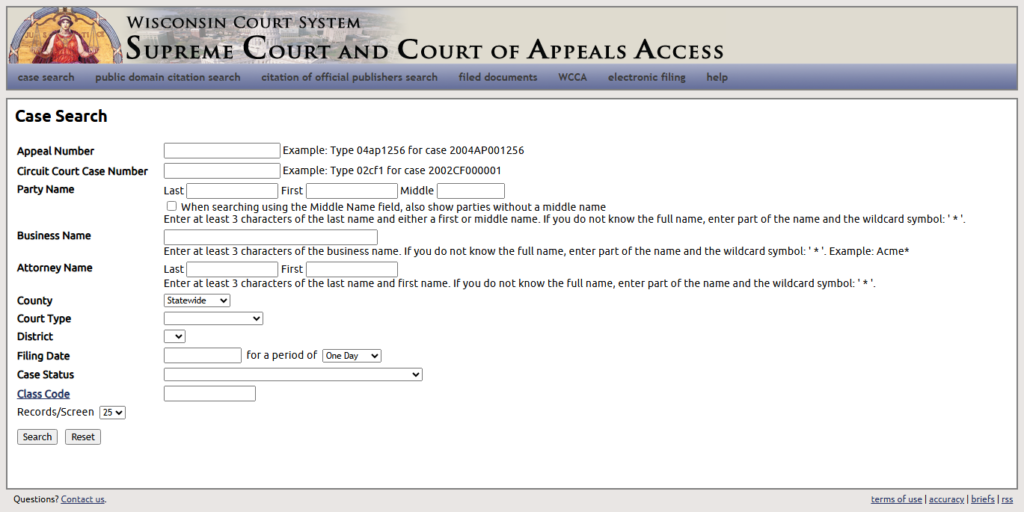
Choose a Search Method
You can search cases using any one of the following options:
- Appeal Number
Enter the full appeal number if available (example:04AP1256). - Circuit Court Case Number
Use this option if you know the exact circuit court case number. - Party Name
Enter the Last Name (required).
You may also add First Name or Middle Name for better accuracy.
At least 3 characters of the last name are required. - Business Name
Enter at least 3 characters of the business name.
You can use a wildcard (*) if the full name is unknown (example:Acme*). - Attorney Name
Enter the attorney’s last name and first name (minimum 3 characters).
Apply Optional Filters
To narrow down your results, you may use additional filters such as:
- County (or keep it set to “Statewide”)
- Court Type
- District
- Filing Date (select a date range)
- Case Status
- Class Code
These filters help refine search results, but are not mandatory.
Start the Search
After entering the required information, click the Search button at the bottom of the page.
View Case Results
The system will display a list of matching cases.
Click on a case number to view detailed case information, including parties, filings, and case status.
Reset the Search
To perform a new search, click the Reset button to clear all fields.
Steps to search online:
- Open the WCCA Case Search page above.
- Pick your search type (party name, case number).
- Choose Brown County as the jurisdiction.
- Review results, including case status and docket entries.
Notes for online search:
- Most public records are free to view online.
- Certain cases (sealed or involving sensitive parties) are restricted.
- Official PDFs of public case documents may be available for download.
How to Search Court Records In Person
Visiting the Brown County Clerk of Circuit Court office lets users access records that may not be viewable online.
Clerk’s office details:
- Address: 100 South Jefferson Street, Green Bay, WI 54301
- Phone: (920) 448‑4160
- Hours: Mon–Fri, 8:00 AM – 4:30 PM
Steps for in‑person lookup:
- Go to the Clerk of Courts’ office.
- Provide the party name, case number, or filing date.
- Indicate the type of case (civil, criminal, probate, family).
- View electronic or paper files.
On‑site public computers often let you search the same WCCA database with staff assistance.
Fees for Viewing and Getting Records
Below is a quick reference for costs tied to court records and documents:
| Action | Cost | Notes |
|---|---|---|
| Online case search | Free | Applies if the staff performs a case lookup |
| Download PDF court documents | Varies | Some documents downloadable; specific fees may apply |
| Printed copies (in person) | About $1.25 per page | Standard paper copies |
| Certified copies | About $5.00 each | Official stamped copies |
| Staff search assistance | Additional fee (about $5 if no case number)** | Some documents are downloadable; specific fees may apply |
Court Divisions in Brown County
Brown County courts are organized into specialized divisions that handle different types of cases based on their jurisdiction. These court divisions provide clarity for residents by directing disputes, criminal matters, family issues, and probate cases to the appropriate legal authority, ensuring cases are handled efficiently and according to state law.
Civil Court Division
The Civil Court Division manages disputes between individuals, businesses, or organizations, focusing on civil cases like contract disagreements, personal injury claims, property disputes, and small claims. Judges oversee trials, motions, and settlements, ensuring parties receive fair outcomes and remedies such as damages or injunctions while maintaining a clear distinction from criminal prosecutions.
Criminal Court Division
The Criminal Court Division addresses offenses against the law, handling criminal cases from minor misdemeanors to serious felonies. It works with prosecutors, law enforcement, and defense attorneys to conduct hearings, trials, and sentencing, enforcing legal authority, protecting public safety, and ensuring due process for all defendants.
Family and Domestic Relations Court
The Family and Domestic Relations Court handles family law matters, including divorce, child custody, support disputes, domestic violence cases, and adoption. This division prioritizes the welfare of children and dependents while providing legal remedies, often using mediation or formal hearings to resolve conflicts fairly and efficiently.
Probate and Estate Court
The Probate and Estate Court manages probate matters and estate administration, validating wills, appointing executors, supervising trusts, and distributing assets according to law. This division ensures estates are handled properly, disputes are resolved, and the legal rights of heirs and beneficiaries are protected throughout the process.
Table of Brown County Court Divisions
| Court Division | Key Responsibilities | Types of Cases |
|---|---|---|
| Civil Court Division | Resolves disputes between parties | Contracts, personal injury, property |
| Criminal Court Division | Prosecutes violations of the law | Misdemeanors, felonies, sentencing |
| Family and Domestic Relations Court | Manages family-related legal matters | Divorce, custody, domestic violence |
| Probate and Estate Court | Administers estates and oversees probate matters | Wills, trusts, estate distribution |
Role of the Brown County Clerk of Court
The Brown County Clerk of Court manages court records, filings, and administrative duties that keep the judicial system organized and efficient. The clerk serves as the main point of contact for public services related to court documentation and procedural support.
The Brown County Clerk of Court plays a central role in court administration, ensuring that legal processes run smoothly. Unlike judges, who decide cases and interpret the law, clerks focus on managing the administrative and procedural aspects of the court. This includes handling court filings, maintaining records, issuing official documents, and supporting judges by organizing case schedules.
Clerk Responsibilities
Clerks handle a wide variety of tasks that are essential to the court system, including:
- Record keeping: Maintaining accurate civil, criminal, and family court records.
- Case management: Filing legal documents and ensuring they are properly recorded.
- Public service: Providing certified copies of court records, marriage licenses, and other official documents.
- Financial duties: Collecting fines, fees, and court costs.
These responsibilities make the clerk a critical link between the court, attorneys, and the public.
Difference Between Judges and Clerks
While a judge rules on cases, issues orders, and interprets the law, the clerk manages the administrative side of the court. Clerks do not make legal decisions but ensure that all case documents are filed correctly, deadlines are met, and the court operates efficiently.
Records Management
One of the key roles of the Brown County Clerk of Court is records management. Clerks maintain comprehensive and organized databases of court cases, motions, judgments, and legal filings. Proper records management allows attorneys, parties, and the public to access reliable information quickly.
Public Services Provided
The Brown County Clerk of Court provides several services directly to the public, including:
- Issuing marriage licenses and certificates
- Providing certified copies of court documents
- Recording deeds, liens, and other legal documents
- Assisting with court fee payments and forms
These services make the clerk’s office an essential resource for residents needing official court documents or administrative assistance.
Brown County Court Records and Case Access
Brown County court records are official documents that track legal proceedings, and anyone can search them to find case information. These records include details about criminal, civil, probate, and family court cases. Court records serve as public documentation of a wide range of legal activities. They provide information about court filings, hearing dates, judgments, and case outcomes.
Types of records available include:
- Case summaries: Brief overviews of a case, including parties involved, case number, and status.
- Docket information: Lists of court proceedings and scheduled hearings.
- Official documents: Filings such as complaints, motions, judgments, and orders.
- Probate and family records: Wills, divorces, child custody, and adoption cases.
It is important to differentiate case information from official court documents. Case information gives general updates and summaries, which are useful for reference or research. Official documents carry legal authority and can be required for legal proceedings, background checks, or verification purposes.
Public Access to Brown County Court Records
Members of the public can access records in several ways:
- Online case search: Many courts provide searchable databases for recent and historic cases. Users can search by case number, party name, or filing date.
- Clerk of Court offices: Physical access to files is available at the courthouse, often with staff assistance for locating documents.
- Requesting copies: Official documents can be requested for a fee, either in person or through the court’s website if available.
Tips for case lookup:
- Always confirm the correct spelling of party names to avoid missed records.
- Use case numbers for the fastest and most accurate results.
- Some sensitive records may be restricted or sealed by court order.
How Legal Authority Works in Brown County Courts
Legal authority in Brown County courts defines how judges make decisions and enforce laws within their jurisdiction. Judges exercise judicial power under established rules while higher courts provide oversight through appeals.
In Brown County, judges hold the primary authority to interpret and apply the law in civil, criminal, and administrative cases. Their authority comes from state law, which outlines what cases the courts can hear and the limits of their judicial power. Judges rely on statutes, legal precedents, and procedural rules to ensure that decisions are lawful and fair. This judicial power also includes issuing orders, hearing evidence, and ruling on motions and trials.
Jurisdiction and Its Limits
Court jurisdiction determines the types of cases a court can handle. In Brown County:
- Subject matter jurisdiction restricts courts to certain case types, such as family, probate, or criminal matters.
- Geographic jurisdiction confines courts to cases arising within the county boundaries.
- Monetary limits can apply in civil cases, defining the maximum financial claim a court may consider.
These limits help residents know which court is appropriate for their legal matters. The court cannot act beyond its jurisdiction, ensuring that legal authority is exercised properly and consistently.
Appeals and Oversight
Brown County courts operate within a hierarchical system, meaning higher courts oversee lower court decisions. If a party believes a judgment is incorrect:
- They can file an appeal to a state appellate court.
- Higher courts review lower court records and rulings.
- They may affirm, reverse, or remand the case for further proceedings.
This oversight maintains accountability and preserves the integrity of judicial power.
Judges and Court Administration in Brown County
The Brown County court system is led by a team of judges and court officials who ensure that justice is delivered fairly and efficiently. Judges oversee cases, make legal decisions, and manage court proceedings in accordance with state law.
The role of judges in Brown County extends beyond hearing cases. They interpret laws, issue rulings, and preside over trials in criminal, civil, and family courts. Each judge is responsible for ensuring that courtroom procedures are followed and that all parties receive a fair hearing. Judges also have the authority to set schedules, manage jury selection, and oversee sentencing when applicable.
Administrative Hierarchy in the Brown County Court System
Court administration in Brown County supports judges and ensures smooth daily operations. The hierarchy includes:
- Clerks of Court: Handle filings, maintain court records, and provide public access to documents.
- Court Administrators: Coordinate schedules, manage staff, and oversee budgeting for court operations.
- Court Support Staff: Include bailiffs, court reporters, and administrative assistants who assist in the smooth functioning of courtrooms.
This structured hierarchy helps maintain order and efficiency, allowing judges to focus on case decisions while administrative officials manage operational tasks.
Court Governance and Oversight
Governance in the Brown County court system involves coordination between judges, elected officials, and administrative staff. Policies and procedures are established to ensure transparency, accountability, and consistency in judicial processes. Regular audits, staff training, and adherence to state judicial standards keep the system functioning effectively.
By clearly separating judicial duties from administrative responsibilities, the court ensures that legal decisions are impartial while day-to-day operations remain well-organized. This separation also allows for efficient case management and timely access to court services for the public.
Legal Process in Brown County Courts: Steps
The legal process in Brown County courts follows a structured sequence that moves from filing a case to final resolution. Both civil and criminal cases follow similar stages, though specific procedures can differ depending on the case type.
Case Filing and Initial Procedures
Every case in Brown County courts begins with filing a complaint or petition. Plaintiffs in civil cases submit a formal complaint to the court, while criminal cases typically start with charges filed by the district attorney. Once filed, the court assigns a case number and schedules an initial appearance.
Key steps in this stage include:
- Submitting required forms to the court clerk
- Paying filing fees or requesting fee waivers if eligible
- Serving notice to the opposing party in civil cases
The purpose of this stage is to formally notify all parties and establish the court’s jurisdiction over the case.
Hearings and Pretrial Procedures
After filing, cases proceed to hearings. These may involve pretrial conferences, motion hearings, or arraignments. Civil cases often include discovery phases where parties exchange evidence, while criminal cases may involve preliminary hearings to determine probable cause.
Important points:
- Civil cases: Discovery, mediation, and motion hearings help prepare for trial
- Criminal cases: Arraignment, plea hearings, and bail hearings determine the next steps
- Court schedules are managed by clerks to ensure timely progress
Trial and Resolution
If a case is not resolved through settlement or plea, it proceeds to trial. During trials, evidence is presented, witnesses are called, and both sides make arguments. Civil trials often result in monetary judgments or injunctions, while criminal trials can lead to fines, probation, or incarceration.
Key differences between case types:
| Aspect | Civil Cases | Criminal Cases |
|---|---|---|
| Burden of Proof | Preponderance of evidence | Beyond a reasonable doubt |
| Typical Outcome | Monetary damages or orders | Conviction, sentence, or acquittal |
| Parties Involved | Plaintiff vs. Defendant | State vs. Defendant |
Brown County Courthouse and Court Locations
The Brown County Courthouse at 100 South Jefferson Street in Green Bay, WI, is the main site where administrative court work and many public hearings take place. Brown County courts also operate in several nearby community court locations serving different types of cases and public needs.
The courthouse functions as the central place for official duties like filing cases, serving public records, and supporting judicial operations. It houses administrative offices such as the Clerk of Circuit Court, public counters where people can submit legal paperwork, and courtrooms for civil, criminal, family, and traffic hearings. Brown County, WI. Other court locations across the county, like municipal or joint courts, handle localized matters, including municipal ordinance cases or specialized dockets.
Main Brown County Courthouse – Core Contact Info
Here is key contact information for the primary courthouse and circuit court administration:
Brown County, WI Courthouse
- Street: 100 South Jefferson Street, Green Bay, WI 54301
- Mailing: P.O. Box 23600, Green Bay, WI 54305‑3600
- Phone (Clerk of Circuit Court): (920) 448‑4155
- Fax: (920) 448‑4156
- Office hours: Monday–Friday, 8 a.m.–4:30 p.m (with a lunch break)
- Email (Clerk): John.Vanderleest@wicourts.gov
At this location, court staff manage case files, maintain public records, orchestrate jury administration, and assist citizens at the public counter.
Other Court Locations in Brown County
Brown County’s system includes several additional sites where court proceedings and services happen:
Brown County Joint Municipal Court (De Pere area)
- Court site: 5718 Dickinson Road, De Pere, WI 54115
- Mail: PO Box 278, Wrightstown, WI 54180
- Phone: (920) 660‑2331
- Email: bcjmc@wi.gov
Other smaller municipal courts serve communities such as Pulaski, Hobart, and Allouez with their own local contact numbers and facilities.
Public Access and Services
Court facilities are open to the public during regular business hours and include:
- Filing counters for civil, criminal, and traffic filings
- Public waiting areas and help desks for forms and procedures
- Courtrooms where scheduled hearings and trials occur
These locations support broad public access to case calendars, records, and legal services. Staff at public counters guide visitors on where to file documents or which court handles specific matters.
Frequently Asked Questions About Brown County Court
Brown County Court handles a wide range of civil, criminal, and administrative cases. The courthouse provides a formal setting for hearings, trials, and filing legal documents.
What Cases Does Brown County Court Handle?
Brown County Court manages civil disputes, criminal cases, family law matters, probate cases, and traffic violations. Civil cases often involve property disputes, contract issues, or personal injury claims, while criminal cases range from minor offenses to serious felonies. Family law matters include divorce, child custody, and support arrangements. Probate cases handle wills, estates, and guardianships, ensuring legal matters are resolved properly. Traffic violations, including fines and hearings, are also addressed by the court. Overall, the court ensures that a wide variety of legal issues are handled fairly and according to state law.
What Is the Difference Between a Courthouse and a Court?
The courthouse is the building where judicial activities take place, including courtrooms, clerk offices, and administrative functions. The court, on the other hand, refers to the legal authority that decides cases, interprets laws, and issues rulings. While the courthouse provides the physical space for proceedings, the court represents the formal legal process and decision-making. A judge holding a hearing works in the courthouse, but the term “court” refers to the legal proceedings themselves.
How Does Court Jurisdiction Work?
Jurisdiction determines a court’s authority to hear and decide specific cases. Brown County Court has geographic jurisdiction over cases filed within the county and subject-matter jurisdiction over certain types of cases, such as civil, criminal, family, or probate matters. Some cases are heard in specialized divisions to ensure expertise in handling the matter. Understanding jurisdiction ensures cases are filed in the proper court and are processed efficiently without delays or procedural issues.
How Can People Access Court Information?
Court records, case schedules, and related information are maintained by the clerk of court. Individuals can visit the courthouse to view public records, check hearing dates, or request copies of documents. Many records are also available online through official county portals. Contacting the court staff by phone or email can help with procedures, document requests, and filing requirements. Access to accurate court information ensures transparency and helps individuals comply with legal procedures effectively.
What Is the Role of Court Divisions?
Brown County Court is organized into divisions that handle specific legal matters to improve efficiency. Civil, criminal, family, and probate divisions ensure that cases are managed by specialized judges and staff. Each division follows its own rules, schedules hearings, and maintains records, allowing legal matters to progress smoothly. This structure helps the court deliver timely resolutions and ensures that each case receives attention from experienced personnel familiar with the relevant area of law.