The Brown County Circuit Court is the main trial court in Brown County, handling a wide range of legal matters. It hears civil disputes, felony cases, traffic violations, family issues, and probate matters. Judges oversee cases, apply state laws, and ensure fair hearings. The court also schedules trials and manages public records of judicial proceedings. Its role is central to maintaining law, order, and justice in the county.
As a trial court, the Brown County Circuit Court resolves conflicts between individuals, organizations, and the state. Commonly referred to as the Brown County Court, it plays a central role in administering justice at the local level. Its civil jurisdiction covers property disputes, contracts, and personal injury cases, while felony cases include serious criminal offenses. The Brown County Court also handles divorces, child custody matters, wills, and estate proceedings. By providing structured legal processes, it ensures that citizens can address disputes efficiently. Through its operations, the court serves the community by maintaining fairness, transparency, and adherence to the law.
Brown County Circuit Court Functions and Authority
The Brown County Circuit Court serves as the primary trial court in Brown County, handling both civil and criminal matters. It manages cases ranging from minor disputes to serious felony charges, ensuring justice is applied fairly within the county.
The Circuit Court is the main trial-level court in Brown County and operates under the state judicial system. It has the authority to hear cases for the first time, which is known as original jurisdiction. This means that the court determines facts, applies the law, and issues rulings or sentences, rather than reviewing decisions from other courts. Cases filed in this court progress through formal judicial proceedings, including hearings, trials, and, when necessary, appeals.
Types of Cases Handled
The Brown County Circuit Court manages a wide variety of case types. These include:
- Civil cases: Disputes between individuals or businesses over contracts, property, or damages. Civil jurisdiction allows the court to decide these matters and order remedies.
- Criminal cases: Includes felony cases such as theft, assault, or other serious crimes. The court determines guilt and sentencing.
- Family and probate cases: Matters like divorce, child custody, wills, and estates.
- Small claims: Disputes involving smaller amounts of money are resolved quickly and with simplified procedures.
- Traffic violations: Major offenses, including DUI and other serious traffic-related cases.
This wide range of cases makes the circuit court a central hub for legal matters in Brown County, providing structured procedures to ensure fairness and efficiency.
How Cases Progress
When a case begins in the Brown County Circuit Court, it follows a structured path. First, filings and complaints are submitted to the court. Judges then schedule hearings, during which evidence is presented, and legal arguments are made. For civil and criminal matters, the court may hold a trial to determine the outcome. Judicial proceedings are designed to ensure both parties have a fair chance to present their case.
Original jurisdiction is a key concept in this process. It means the circuit court has the authority to hear cases for the first time, unlike appellate courts that only review prior decisions. After the court issues a judgment, parties may have the option to appeal to a higher state court if they believe errors occurred during the trial.
Circuit Cases — Court Records Search and Costs
Users looking to access Brown County circuit cases can search official databases to find case information, dockets, and filings. Records are available online for most public cases, while sealed or expunged cases remain restricted.
How to Search Brown County Circuit Cases
The most reliable way to find court records is through the Wisconsin Circuit Court Access (WCCA) portal. The search process is simple and user-friendly.
Wisconsin Circuit Court Case Search – Steps
• Open the official case search page:
https://wcca.wicourts.gov/case.html
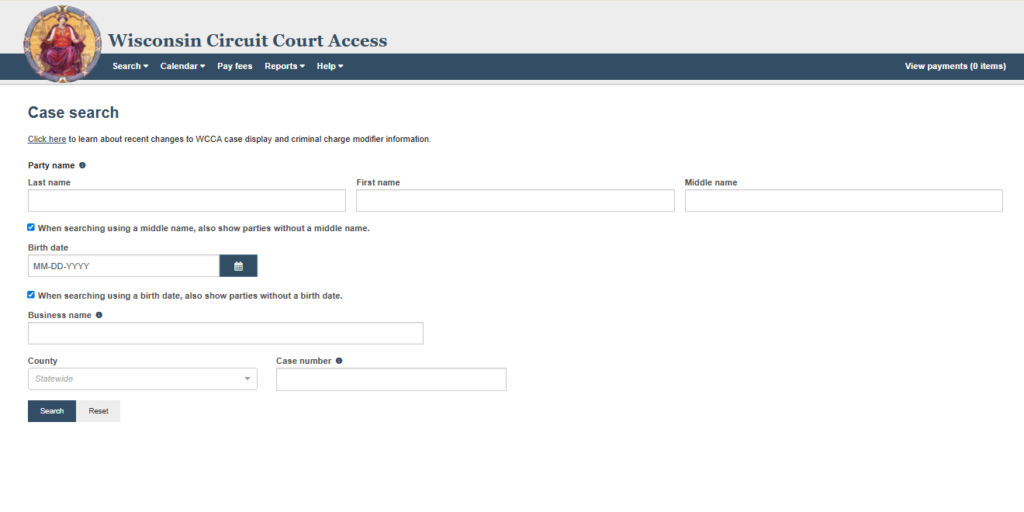
- Enter the Last Name of the person you want to search (required)
- Add the First Name or Middle Name for more accurate results (optional)
- Select the checkbox to include records without a middle name (optional)
- Enter the Birth Date (MM-DD-YYYY) to narrow search results (optional)
- Select the checkbox to include records without a birth date (optional)
- Enter a Business Name if the case involves a company or organization
- Type the Case Number if you know the exact number for faster results
- Choose a County or keep it set to Statewide to search all Wisconsin counties
- Click the Search button to view matching case records
- Click on a case number to see detailed case information
- Use the Reset button to clear all fields and start a new search
Where to View Records
Brown County circuit records can be accessed through multiple channels:
- WCCA Online Case Search: Free for most public cases; provides dockets, filings, and case summaries.
- Brown County Clerk of Courts Office: In-person access to physical or certified copies of court records.
- Third-Party Legal Services: Some private websites offer record searches for a fee, though official sources are recommended for accuracy.
Costs for Viewing and Downloading Records
Most online case searches through WCCA are free. However, obtaining official or certified documents can have associated costs. Below is a breakdown:
| Service | Availability | Cost |
|---|---|---|
| Online case search (WCCA) | Free | $0 |
| PDF download of filings (online) | Selected documents | Free – $5 per document |
| Certified copies from clerk’s office | All official records | $1–$3 per page, $10–$20 for full case file |
| Court forms (civil/family) | Online or clerk’s office | Free |
| Expedited or mailed copies | Clerk’s office request | Additional $5–$10 fee |
Clerk of Circuit Court — Duties & Services
The Clerk of Circuit Court in Brown County manages court records, handles filings, and collects fees for cases. They also provide direct assistance to the public for obtaining copies, reviewing minutes, and tracking case progress.
Role in Case Management and Records
The Clerk of Circuit Court serves as the central administrative officer for Brown County’s circuit courts. Their duties include:
- Maintaining court records: All civil, criminal, probate, and family court records are securely stored and indexed.
- Managing case filings: The clerk ensures documents such as complaints, motions, and pleadings are properly recorded.
- Collecting fees and fines: Filing fees, service fees, and court costs are handled promptly and accurately.
- Scheduling and calendars: The office assists in setting court dates and managing the official docket.
Staff work closely with judges, attorneys, and the public to ensure cases progress efficiently. Clear record-keeping helps prevent delays and ensures all parties have access to accurate information.
Public Assistance and Services
Brown County residents rely on the clerk’s office for a variety of services. Court staff provide support for:
- Requesting copies of court documents
- Reviewing minutes from hearings
- Indexing and searching court records
- Assisting with forms for civil, family, and criminal cases
- Explaining fee structures and payment methods
The office is also a helpful resource for people representing themselves in court. Staff can clarify procedural questions, though they cannot provide legal advice.
Administrative Support
The clerk’s office supports court administration by coordinating between judges, attorneys, and other county departments. Key functions include:
| Service | Description |
|---|---|
| Record Keeping | Maintains and indexes all court filings and minutes |
| Public Services | Provides certified copies and helps with document requests |
| Fee Collection | Collects filing fees, fines, and court costs |
| Case Tracking | Updates case statuses and maintains official calendars |
Circuit Court Judges — Who They Are & What They Do
Circuit court judges are the primary decision‑makers in Brown County’s trial court system. These judges hear cases, decide on legal questions, and make rulings that affect people and businesses in the community.
Presiding Judge & Bench
In Brown County, Wisconsin, the Circuit Court bench includes multiple judges based at the Brown County Courthouse in Green Bay, WI. One judge may serve as the presiding judge. This person helps manage the work of the court and supports fair daily operations.
The bench handles a wide range of matters, from traffic cases to serious criminal charges. Judges often work in separate divisions like civil, criminal, family, and juvenile courts. They run courtroom sessions, listen to lawyers, review evidence, and make rulings based on Wisconsin law.
Here are the core duties of a circuit court judge in Brown County:
- Lead court sessions with fairness and order.
- Review legal filings and decide if they meet statutory requirements.
- Issue orders that affect custody, fines, or sentencing.
- Explain rulings so people in the courtroom understand the results.
Residents see these judges regularly, as they live, work, and hold office in the community. Having judges based in Green Bay makes the court accessible to people with business before the court.
Judicial Roles & Election/Appointment Info
In Wisconsin, circuit court judges are elected by voters in each county. These elections are officially non‑partisan. Judges serve six‑year terms once elected. If a vacancy happens mid‑term, the governor may appoint a replacement who must then stand for election to keep the seat.
People can check current judges and election details on resources like Ballotpedia, which tracks local government information and election results. Voters decide which candidates will serve on the bench. This gives residents a direct voice in who applies state law in their community.
Judges must meet state qualifications before they serve. That generally includes:
- Being a U.S. citizen.
- Being licensed to practice law in Wisconsin.
- Living in the circuit they serve.
Candidates often share their background and priorities in campaign materials. This helps voters weigh experience and philosophy before casting a ballot.
What Decisions Judges Make During Judicial Proceedings
Circuit court judges make key decisions every day in Brown County courtrooms. Their role is not limited to trials. Judges guide the legal process from start to finish. They:
- Set bail or release conditions while someone waits for trial.
- Rule on motions, such as whether certain evidence can be used.
- Decide guilt or innocence in bench trials where there is no jury.
- Instruct juries on the law when juries are present.
- Issue sentences after a conviction, which can include fines, jail, or other orders.
- Handle disputes over child custody and support.
Judges must follow Wisconsin statutes and court rules. They use case law and legal standards to shape rulings. Each decision includes reasons that reflect the evidence presented and relevant law.
Types of Hearings & What to Expect
Circuit court hearings are shorter judicial proceedings that focus on specific issues in a case, while trials resolve the case in full. In Brown County, hearings include preliminary matters, status checks, and felony arraignments, each with its own procedures and expectations. Court dockets provide an organized schedule of these hearings and trials, allowing the public and legal professionals to track upcoming cases efficiently. Accessing the court docket ensures transparency and helps parties prepare appropriately for their scheduled matters.
Hearings vs. Trials
A hearing is a scheduled session where a judge addresses particular questions, motions, or updates in a case. Common types include:
- Preliminary hearings: Determine whether enough evidence exists to proceed with felony charges.
- Status conferences: Update the court on case progress and set future dates.
- Felony arraignments: Formal reading of charges and entry of pleas.
In contrast, a trial is a full proceeding where evidence and witness testimony are presented, leading to a verdict. Hearings are usually shorter, less formal, and focused on legal or procedural matters rather than the final decision.
How Hearings Work
During a hearing, participants should expect the following:
- Courtroom etiquette: Arrive on time, dress professionally, and address the judge respectfully.
- Proceedings: The judge may ask questions, review motions, or schedule additional hearings.
- Participants: Attorneys, defendants, victims, and occasionally witnesses attend.
- Documentation: Any relevant forms or evidence should be ready for submission.
Hearings follow the court’s hearing schedule and are listed on the trial calendar, which is available through the Brown County Circuit Court website. Attendees should check the schedule ahead of time to confirm their appearance date.
What to Expect at Felony Hearings
Felony hearings in Brown County often involve critical steps in criminal cases. These may include:
- Arraignment hearings: Charges are formally presented, and the defendant may enter a plea.
- Bail hearings: Judges determine release conditions and set bail amounts.
- Pretrial conferences: Lawyers and the judge discuss case preparation, evidence exchange, and upcoming trial dates.
Accommodations & Procedural Notes
The court provides certain accommodations for participants, including:
- Accessibility: Wheelchair ramps and accessible seating.
- Language assistance: Interpreters for non-English speakers.
- Scheduling considerations: Requests for date changes due to emergencies or conflicts.
Participants should submit accommodation requests ahead of the hearing. Judges aim to maintain an orderly environment, so proper etiquette and respect for court rules are expected at all times.
How to File a Case / Court Forms & Procedures
Filing a case in Brown County Circuit Court begins with selecting the correct court form and following the established filing procedures. The court provides resources for civil, criminal, and family cases, including fee schedules and submission methods.
Court Forms Available
Brown County Circuit Court offers a variety of forms for different case types:
- Civil Cases: Complaint forms, summons, motions
- Criminal Cases: Indictments, plea forms, bond motions
- Family Cases: Divorce petitions, child custody forms, protective orders
Forms can be obtained online from the Brown County Circuit Court website or in person at the clerk’s office. Each form includes instructions on filling out necessary fields, required attachments, and signatures.
Filing Procedures
Once the correct form is selected, follow these procedures:
- Complete the Form: Fill in all required information clearly and accurately.
- Calculate Filing Fees: Fees vary by case type. Civil cases typically range from $100–$300, while family or criminal filings may differ. Check the latest fee schedule on the court’s website.
- Submit the Form: Forms can be filed:
- In Person: At the Brown County Circuit Court clerk’s office
- eFiling: Some case types allow electronic filing through the state eFiling portal
- Mail: Certain filings may be accepted via certified mail
Pro Se Filing: Individuals representing themselves must follow the same steps. The court provides resources and instructions for pro se filers.
Filing Calendar and Deadlines
Brown County Circuit Court maintains a filing calendar that tracks deadlines for submitting petitions, responses, and motions. Missing a deadline can result in dismissal or delay, so it’s important to check the calendar for your case type.
| Case Type | Filing Method | Typical Filing Fee | Notes |
|---|---|---|---|
| Civil | In-person/eFiling | $100–$300 | Fee depends on case complexity |
| Family | In-person/eFiling | $120–$350 | Additional fees for custody or support cases |
| Criminal | In-person | Varies | Court may waive fees for certain motions |
Brown County Circuit Court Location, Hours & Contact
The Brown County Circuit Court office is located in Green Bay, providing public access for legal proceedings, filings, and general court services. Visitors can reach the courthouse easily by car or public transport, and the office maintains regular hours for inquiries and document submissions.
Courthouse Address & Directions
The Brown County Circuit Court is situated at:
Brown County Courthouse
100 S. Adams Street, Green Bay, WI 54301
It is located in downtown Green Bay, near the Fox River and next to City Hall. Public parking is available at the courthouse lot and nearby municipal garages. Handicapped-accessible entrances are provided at the main building. Visitors using GPS or Google Maps can search for “Brown County courthouse address” for accurate directions.
Parking & Accessibility Notes:
- Public parking lots are adjacent to the courthouse.
- Street parking is available but limited during weekdays.
- Wheelchair-accessible ramps and elevators are at the main entrance.
- Security screening is required for all visitors.
Office Hours
The Brown County Circuit Court office is open for public access according to the following schedule:
| Day | Hours |
|---|---|
| Monday – Friday | 8:00 AM – 4:30 PM |
| Saturday | Closed |
| Sunday | Closed |
During these hours, the office handles filings, document requests, and inquiries. Early arrivals are recommended for those submitting forms or attending hearings.
Contact Information
The court provides multiple ways to contact staff for questions or official business:
- Phone: (920) 448-4015
- Fax: (920) 448-4017
- Email: circuitcourt@browncountywi.gov
FAQs – About Circuit Court
Brown County circuit cases include hearings and trials, which serve different roles in the legal process. Hearing dates can be found on court calendars, and many hearings are open to public observation.
What is the difference between hearings & trials?
Hearings and trials serve distinct purposes in Brown County circuit cases. A hearing is usually a shorter session where a judge addresses procedural matters, reviews motions, or resolves specific issues in a case, such as scheduling or temporary orders. Trials, by contrast, are formal proceedings where both sides present evidence, witnesses, and full legal arguments to determine the outcome of a case. While hearings help manage the flow of cases and keep proceedings organized, trials provide a full examination of the case and result in a judgment or verdict. Understanding this distinction helps parties prepare appropriately for each stage and ensures the case moves efficiently through the circuit court system.
How do I find my hearing date?
Hearing dates for Brown County circuit court cases are available through online court calendars or by contacting the clerk’s office. Court calendars provide details such as the case number, judge, courtroom, and scheduled date and time. By entering your case information into the court’s online search tool, you can confirm when and where your hearing will take place. In addition to online resources, parties often receive written notifications by mail for upcoming hearings. Staying aware of these dates is essential to comply with deadlines and participate fully in proceedings, whether you are representing yourself or working with an attorney.
Can I watch a hearing?
Most hearings in Brown County circuit courts are open to the public, allowing individuals to observe proceedings in person or, in some cases, online. In-person attendance usually requires visiting the courthouse at the scheduled time, following security protocols, and observing courtroom rules. Some hearings may be streamed through the court’s digital platform, which allows for remote viewing of certain proceedings. However, sensitive cases such as juvenile matters or sealed proceedings may be restricted. Checking the court calendar and verifying access rules ensures that anyone interested in public access to proceedings can attend or observe hearings safely and respectfully.
How can I check the status of my case?
The status of Brown County circuit cases can be monitored through the court’s online case search or by contacting the clerk’s office directly. Case status information includes upcoming hearings, motions filed, and recent rulings. Keeping track of your case status helps parties stay informed about deadlines and ensures timely participation in all scheduled proceedings. Accessing this information online or through the clerk’s office is the most reliable way to remain updated about circuit court hearings and case progress.
What documents do I need to bring to a hearing?
Attending a hearing in Brown County circuit court typically requires bringing identification, any relevant case documents, and copies of evidence that may be presented. This can include motions, pleadings, contracts, or correspondence related to the case. Having organized documents ensures smoother proceedings and allows the judge or court staff to reference the correct materials efficiently. Parties should review any instructions provided with the hearing notice to confirm all required items and avoid delays during the session.